Nutrition for Muscle Gain: How Much to Eat, What to Eat and When — A Complete Beginner's Guide
Building muscle is not just about training to failure. It is systematic work where nutrition plays just as important a role as the barbell or dumbbells. You can train five times a week
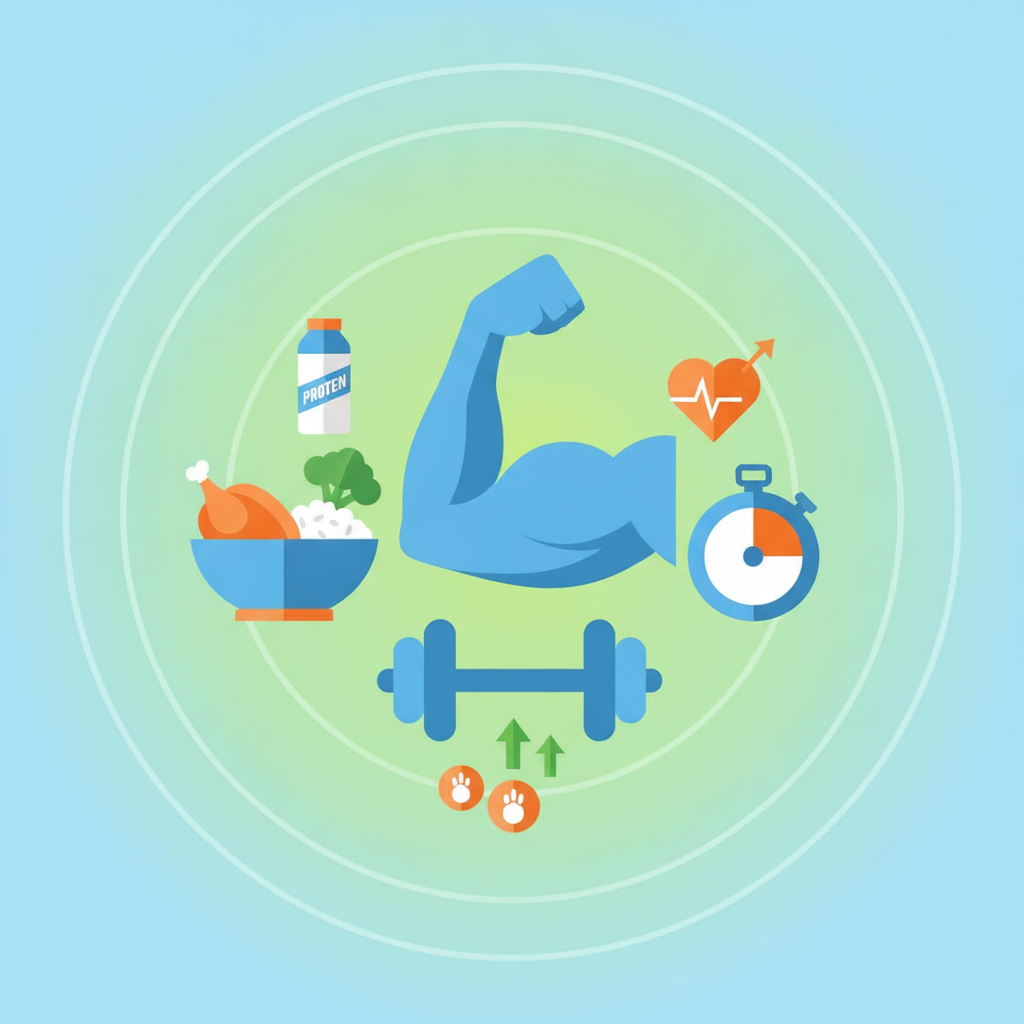
Building muscle is not just about training to failure. It is systematic work where nutrition plays just as important a role as the barbell or dumbbells. You can train five times a week and still see no growth if your diet does not match the goal. This guide breaks down how to structure your nutrition for muscle gain from scratch: which nutrients you need, in what quantities, and at what time of day.
Why Nutrition Is the Foundation of Muscle Gain
Muscle is biological tissue that requires building material to grow. Training only creates stress and a signal for adaptation, but the actual growth happens during recovery and only when there is a sufficient supply of protein and energy from outside.
Without a calorie surplus, the body has no resources to synthesise new muscle fibres. In a calorie deficit, the body switches to conservation mode: it starts burning muscle tissue as fuel rather than building it. This is called catabolism — the opposite of anabolism.
A properly structured diet for muscle growth solves several problems at once:
- Provides building material — amino acids from protein are used to synthesise new muscle fibres.
- Supplies energy — carbohydrates and fats fuel training and recovery.
- Prevents excessive fat gain — a moderate surplus, not uncontrolled overeating.
- Supports hormonal balance — testosterone, growth hormone and insulin are directly dependent on food quality.
Neglecting nutrition during a mass-gaining phase is the most common beginner mistake. If you want to work out the training side of things alongside nutrition, read strength training for beginners: a complete guide to getting started — it covers the principles of building a programme in detail.
How to Calculate Your Daily Calorie Target for Muscle Growth
The first step is to determine your maintenance calorie level (TDEE, Total Daily Energy Expenditure). This is the number of calories at which your weight remains stable. It is calculated using the basal metabolic rate (BMR) formula, which takes into account weight, height, age and sex, multiplied by an activity coefficient.
To gain muscle, a surplus is added to TDEE — typically 250–500 kcal per day. This range is considered optimal according to the American College of Sports Medicine (ACSM): it provides the resources for growth without excessive fat accumulation.
Key points to remember when calculating calories:
- If your weight does not increase over 2–3 weeks, add 100–200 kcal.
- If fat is accumulating quickly, reduce the surplus.
- As body weight increases, TDEE rises too, so the calculation needs to be updated every 3–4 weeks.
- An excessively large surplus (1,000+ kcal) leads to fat gain rather than muscle gain: the body cannot synthesise muscle tissue faster than a certain physiological limit.
Calories for muscle gain are not a licence to eat anything. The sources of those calories matter enormously, and that is what the following sections cover.
The Role of Protein: How Much You Need and Where to Get It
Protein is the key nutrient during a muscle-building phase. New muscle fibres are built from amino acids after training. According to a meta-analysis in the British Journal of Sports Medicine (2017), the optimal protein intake for hypertrophy is 1.6–2.2 g per kilogram of body weight per day. Beginners need the lower end; experienced athletes need the upper end.
For a person weighing 75 kg, this means 120–165 g of protein per day.
The best protein sources for muscle gain:
- Chicken breast — around 31 g of protein per 100 g.
- Eggs — 13 g of protein, high bioavailability.
- Cottage cheese (low-fat or 5%) — 16–18 g of protein, slow-digesting casein.
- Fish (tuna, salmon, cod) — 20–25 g of protein plus healthy fats.
- Legumes (lentils, chickpeas) — 8–9 g of plant-based protein.
What matters is not only the total daily amount, but also spreading protein evenly across meals. Research in The American Journal of Clinical Nutrition (2014) shows that 0.4 g of protein per kg of body weight per meal is a practical target for maximising muscle protein synthesis.
For more on recommended amounts and sources, read how much protein you need per day: targets for weight loss, muscle gain and maintenance.
Carbohydrates for Muscle Gain: Fuel for Growth
Carbohydrates are the primary energy source for intense strength training. They are stored as glycogen in the muscles and liver and used up during exercise. Without enough carbohydrates, training quality drops, recovery slows down and the risk of overtraining increases.
During a mass-gaining phase, carbohydrates should make up 40–60% of daily calories. The priority is complex (slow) carbohydrates with a low glycaemic index.
The best carbohydrate sources for your diet:
- Oats, buckwheat, brown rice, pearl barley — slow release of energy.
- Potatoes and sweet potatoes — filling and provide glucose without sharp insulin spikes.
- Wholegrain bread and durum wheat pasta.
- Vegetables and leafy greens — fibre, micronutrients, digestive support.
After training, fast carbohydrates are also appropriate — a banana, rice cakes, honey. At this point the body actively absorbs glucose to replenish glycogen, and a fast carbohydrate source speeds up recovery.
Fats in Your Diet: Why They Matter for Muscle Gain
Many beginners unnecessarily cut fats, thinking of them as an enemy of their physique. This is a mistake. Fats are an essential component of a muscle-building diet because they are involved in the synthesis of steroid hormones, including testosterone. Low-fat diets (fewer than 15% of calories from fat) lead to a drop in testosterone and a reduced anabolic environment.
The optimal fat intake during a muscle-building phase is 20–35% of daily calories.
Priority sources:
- Avocado — monounsaturated fats, vitamin E.
- Nuts and seeds — Omega-3 and Omega-6, magnesium, zinc.
- Extra-virgin olive oil — cardiovascular protection.
- Fatty fish (salmon, mackerel) — fish oil rich in EPA and DHA.
- Egg yolks — cholesterol needed for hormone synthesis.
Saturated fats (from meat and dairy) are acceptable in moderate amounts. There is no need to eliminate them entirely, but a heavy lean towards animal fats without unsaturated ones is undesirable.
Meal Timing: How to Distribute Your Meals Throughout the Day
Meal frequency affects the stability of amino acid supply to the bloodstream. The optimal approach during a mass-gaining phase is 4–5 meals per day with 3–4 hour intervals. This keeps muscle protein synthesis going throughout the day.
An example daily structure:
- Breakfast — complex carbohydrates + protein (oats with eggs, cottage cheese with fruit).
- Snack — protein + a small amount of fat (nuts, kefir, hard-boiled eggs).
- Lunch — main meal: grains + meat/fish + vegetables.
- Pre/post-workout meal — depends on your schedule (see the next section).
- Dinner/meal before bed — protein + fat without fast carbohydrates (cottage cheese, eggs, fish with vegetables).
Skipping meals — especially breakfast — raises cortisol levels and triggers catabolic processes. A muscle-building menu does not have to be complicated, but it does need to be consistent.
Pre- and Post-Workout Nutrition: What to Eat and When
Pre- and post-workout nutrition directly affects training performance and the speed of recovery.
Before training (1.5–2 hours prior):
- Complex carbohydrates — buckwheat, rice, potatoes.
- A moderate amount of protein — 20–30 g.
- Minimal fat and fibre to avoid slowing digestion.
After training (within 30–60 minutes):
- Fast carbohydrates — banana, rice cakes, isotonic drink.
- Easy-to-digest protein — whey protein, chicken breast, egg whites.
Hydration is equally important: even 2% dehydration reduces strength performance according to the Journal of Strength and Conditioning Research (2007). Drink water before, during and after training.
If you want to understand how to build not just your nutrition but your training programme as well, read how to create a workout programme on your own: a step-by-step plan for beginners. And if you are interested in how AI helps manage load progression, read F/AI and load progression: how the AI coach automatically increases weights.
FAQ
Can you build muscle without sports supplements?
Yes. Protein shakes, gainers and other supplements are simply a convenient way to reach your protein or calorie targets. If you are getting enough protein and energy from regular food, sports supplements are not necessary for beginners. They become relevant when it is hard to eat the required volume of food or there is no time for a full meal after training. First, build your diet from whole foods — that is the foundation. Supplements are only worth considering once your basic diet is already dialled in.
How many times a day should you eat to build muscle?
The optimal frequency is 4–5 meals per day. This allows you to spread proteins, fats and carbohydrates for mass gain evenly, maintain stable amino acid levels in the blood and avoid long gaps that trigger catabolism. If your schedule does not allow five meals, a minimum of three full meals is acceptable, but each should have a strong protein component. Skipping meals cannot be compensated for by increasing the size of the next one.
How do you know if you are eating enough for muscle growth?
Focus on three indicators: body weight is increasing slowly (0.5–1 kg per month is a normal rate), strength numbers in training are going up, and energy levels are stable. If your weight has been stuck for several weeks and training is going well, you are not getting enough calories for muscle gain. Add 200–300 kcal per day and monitor the trend over two weeks. For more on tracking progress, read F/AI: how to track workout progress — what the AI coach records.
Do you need to eat at night to gain muscle?
There is no need to wake up in the middle of the night. However, your last meal before bed should include slow-digesting protein — casein from cottage cheese or egg whites. It provides a gradual supply of amino acids during sleep, when growth hormone is actively released. This reduces overnight catabolism without overloading the digestive system.
What is better — a self-made nutrition plan or help from an AI coach?
A self-made plan works if you are ready to get into the calculations and adjust your diet regularly. If you want a systematic approach without the extra effort — F/AI, the AI coach app (fitgpt.pro), takes into account your profile parameters, goals and schedule, and adjusts the plan as you progress. For more on how the app builds a strategy for a specific individual, read F/AI for muscle gain: how the AI coach builds a programme around your goals.
💪 Want a programme built for you, not a template? F/AI takes into account 23 profile parameters and rebuilds your plan after every workout. Try F/AI →
Try F/AI — AI Fitness Trainer
Personalized workout plans, AI trainer chat, photo body analysis.
Download for free