How to Build Chest Muscles at Home: How Many Sets and Reps You Actually Need for Growth
Learn how to build chest muscles at home with the right sets, reps, and exercises. No gym needed. Start your chest-building plan today!
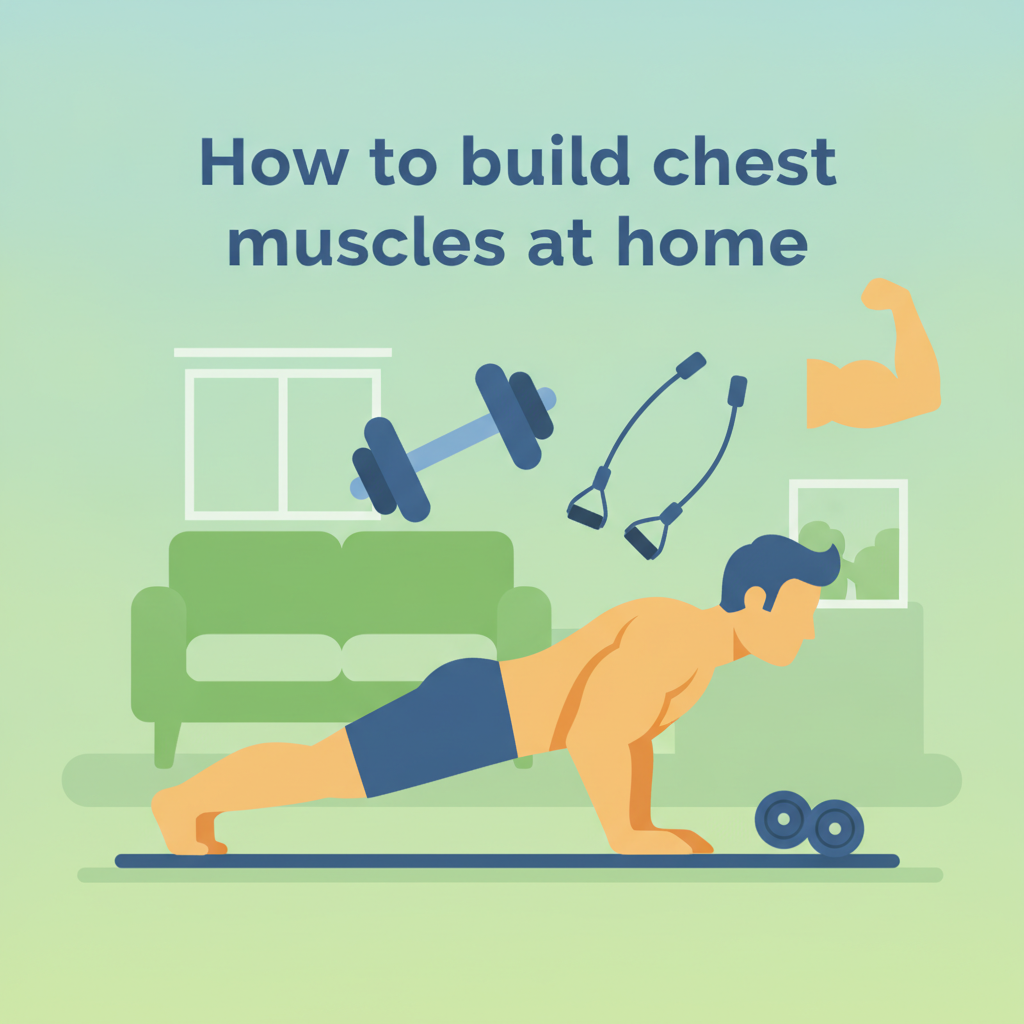
Building a bigger, stronger chest doesn't require a gym membership, a barbell, or a cable machine. If you understand how muscle growth actually works, you can develop serious chest size and definition using nothing but your bodyweight and a floor. This guide breaks down exactly how to build chest muscles at home — covering the right sets, reps, exercises, and progressions to drive real hypertrophy.
Why You Can Build a Bigger Chest at Home Without a Gym
The single most important driver of muscle growth is progressive overload — the gradual increase in stress placed on your muscles over time. That stress doesn't have to come from a barbell. It can come from bodyweight exercises performed with enough intensity, volume, and consistency.
Bodyweight chest exercises like push-up variations generate substantial mechanical tension across the pectoral fibers. When you push a challenging set close to muscular failure, your chest responds the same way it would to a bench press: muscle fibers are damaged, repaired, and rebuilt thicker. That's hypertrophy, and it doesn't care whether the resistance came from iron plates or your own bodyweight.
What matters for a successful no equipment chest workout is:
- Volume: enough total sets per week to stimulate growth
- Intensity: training close to failure, not just going through the motions
- Consistency: showing up regularly over weeks and months
- Progressive overload: making each week slightly harder than the last
This guide will give you the exact framework to apply all four principles at home, starting today.
Understanding Sets and Reps for Chest Muscle Growth
Before you start any home chest workout without weights, you need to understand the basic science of rep ranges and weekly volume.
Hypertrophy rep range: Research consistently shows that any rep range from roughly 6 to 30 reps per set can build muscle, as long as you're training close to failure. Moderate rep ranges of 8–20 are most practical for bodyweight training because they keep time under tension high without requiring you to load a barbell.
Weekly volume: For most people, 10–20 hard sets targeting the chest per week is the effective range for hypertrophy. Beginners can grow on the lower end (8–10 sets), while intermediate lifters typically need 14–20 sets to keep progressing.
Strength vs. hypertrophy: Lower-rep, higher-difficulty sets (5–8 reps of archer push-ups, for example) build both strength and size. Higher-rep sets (12–20 reps of standard push-ups) are better at accumulating volume efficiently. Both have a place in a smart program.
Progressive overload without added weight: Since you can't simply add 5 pounds to a push-up, you track progress by increasing reps per set, adding sets, shortening rest periods, or moving to harder variations. Keeping a workout log is non-negotiable.
The Best Bodyweight Chest Exercises to Do at Home
A complete bodyweight chest workout for mass uses multiple angles to hit all parts of the pectorals — upper, middle, and outer fibers.
Standard push-up Hands shoulder-width apart, elbows at roughly 45 degrees, chest touches the floor. This is your primary horizontal press movement and the foundation of every home chest program.
Wide-grip push-up Hands placed wider than shoulder-width shifts emphasis to the outer chest and increases the stretch on the pecs at the bottom of each rep — a key stimulus for growth.
Diamond push-up Hands form a diamond shape directly under your chest. This variation hammers the inner chest and triceps and increases difficulty significantly.
Decline push-up Elevate your feet on a chair or couch. This angle targets the upper chest fibers — the clavicular head of the pectoralis major — which are often underdeveloped in bodyweight athletes.
Pike push-up Hips high, body in an inverted V. This is primarily a shoulder builder but recruits the upper chest effectively and adds variety to your push-up variations for chest growth.
Archer push-up One arm extended to the side while the other does the pressing work. This is a high-difficulty, unilateral variation that significantly increases the load on each side of your chest — the closest bodyweight equivalent to a single-arm press.
Choosing your exercises: Beginners should master the standard, wide-grip, and decline push-ups before adding harder variations. Intermediate trainees should rotate in diamond and archer push-ups to keep intensity high.
How to Structure Your Home Chest Workout: Sets, Reps, and Rest
Beginner template (weeks 1–4):
- 3 exercises × 3 sets of 8–15 reps
- 2 days per week
- Rest 60–90 seconds between sets
Intermediate template (weeks 5+):
- 4 exercises × 4 sets of 10–20 reps
- 2–3 days per week
- Rest 60–90 seconds for hypertrophy, up to 3 minutes if doing max-effort low-rep sets
Sample weekly schedule:
- Monday: Chest workout
- Tuesday: Rest or lower body
- Wednesday: Rest or upper body pull (rows, chin-ups)
- Thursday: Chest workout
- Friday–Sunday: Recovery and active rest
The most critical rule: train within 2–3 reps of muscular failure. If you can finish a set and feel like you had 10 reps left in the tank, you haven't stimulated enough growth. Push close to the edge, then rest and repeat.
Apply progressive overload weekly by adding 1–2 reps per set, an extra set, or moving to a harder variation when the current one becomes manageable.
Progressive Overload Without Weights: How to Keep Growing
Chest hypertrophy at home stalls when you stop making your workouts harder. Here's your toolkit:
- Harder variations: Progress from standard → wide-grip → decline → diamond → archer push-ups as your load progression
- Slower tempo: Use a 3-1-3 tempo (3 seconds down, 1-second pause, 3 seconds up) to dramatically increase time under tension
- Paused reps: Pause for 2 seconds at the bottom of each push-up to eliminate elastic energy and force the muscles to work harder
- 1.5-rep technique: Lower to the bottom, press halfway up, return to the bottom, then press all the way up — that's one rep
- External resistance: Load a backpack with books or use resistance bands to add measurable weight
- Workout logging: Record every set, rep, and variation. If you're not tracking, you're guessing
When you've exhausted bodyweight progressions, consider adding a dumbbell floor press or purchasing a pair of resistance bands — both allow direct load increases and extend your progress for years.
Common Mistakes That Slow Chest Growth at Home
Avoid these errors to keep your chest hypertrophy at home on track:
- Volume without intensity: Doing 200 easy push-ups does far less than 5 sets of hard, near-failure reps
- Partial range of motion: Your chest must touch or nearly touch the floor on every rep for full muscle activation
- Training daily: Muscles grow during recovery, not during the workout. Give your chest at least 48 hours between sessions
- Ignoring nutrition: You need a slight caloric surplus and 0.7–1g of protein per pound of bodyweight to build muscle — training alone won't do it
- Skipping angles: Only doing flat push-ups leaves your upper and outer chest underdeveloped
- No tracking: Repeating the same workout for months is the fastest path to a plateau
Sample 4-Week Home Chest Workout Plan for Muscle Growth
Week 1 — Foundation Standard push-ups 3×12, wide-grip push-ups 3×10, decline push-ups 3×10. Rest 60–90 seconds. Focus on perfect form and full range of motion.
Week 2 — Volume Increase Add diamond push-ups. All exercises move to 4 sets. Target the top of your rep range from week 1 before adding reps.
Week 3 — Intensity Increase Introduce archer push-ups. Add paused reps (2-second hold at the bottom) to at least one set per exercise. Total volume: 16–18 sets per session.
Week 4 — Deload or Peak Test Option A (deload): Reduce to 2 sets per exercise at lower intensity to allow full recovery. Option B (peak): Max-rep test on standard push-ups to measure improvement from week 1.
Beyond 4 weeks: Cycle difficulty by alternating high-volume phases (more sets, moderate reps) with high-intensity phases (harder variations, lower reps close to failure). Adjust based on soreness and recovery — if you're still sore on your next chest day, rest another 24 hours.
FAQ
How many push-ups should I do to build chest muscle? Stop thinking about a fixed number of push-ups and start thinking about challenging sets. Three to five sets taken close to muscular failure will stimulate far more chest growth than 100 easy, comfortable push-ups done without real effort. If you can do 30 push-ups in a row with energy to spare, the standard push-up is no longer a growth stimulus — you need to make it harder by using a more demanding variation, slowing the tempo, or adding external resistance. Quality and proximity to failure matter far more than raw repetition count.
Can I build a big chest with only bodyweight exercises? Yes, absolutely — provided you apply progressive overload consistently over months and years. Countless athletes and calisthenics practitioners have developed well-defined, muscular chests using only push-up variations. The key is never letting your body fully adapt to the current difficulty level. As long as you keep progressing to harder variations, adding tempo work, and training with real intensity, your pectorals will respond and grow just as they would to a bench press program.
How often should I train my chest at home for the best results? For most people, training chest 2–3 times per week with at least 48 hours between sessions produces the best results. This frequency allows enough volume to drive hypertrophy while giving the muscle tissue adequate time to recover and grow. Training chest every day is counterproductive — you're breaking down tissue faster than your body can repair it. If you feel significant soreness going into your next session, take an extra rest day rather than forcing it.
How long does it take to see chest muscle growth at home? Expect to see noticeable changes in chest size and definition within 8–12 weeks, assuming you're training consistently, applying progressive overload each week, and eating enough protein and total calories to support muscle growth. You'll likely feel strength improvements much sooner — often within 2–3 weeks. Visible muscle development takes longer because it depends on both muscle fiber growth and sufficiently low body fat to make that muscle visible.
Do I need protein supplements to build chest muscles at home? No. Protein supplements are convenient, not necessary. Your body doesn't distinguish between protein from chicken, eggs, Greek yogurt, and a whey shake. What matters is hitting your daily protein target — roughly 0.7 to 1 gram per pound of bodyweight. If you can meet that through whole foods alone, you don't need to spend money on supplements. Use them only as a practical shortcut when hitting your protein goal through food becomes difficult on a given day.
💪 Train smarter with f/ai — an AI coach builds a personal program for your goals and adapts as you progress. Get the app →
Try F/AI — AI Fitness Trainer
Personalized workout plans, AI trainer chat, photo body analysis.
Download for free