How to Build Abs at Home: A 4-Week Programme Without Equipment
Defined, strong abs are one of the most popular fitness goals. The good news: you don't need a gym membership or expensive equipment to achieve them. All it takes is a free
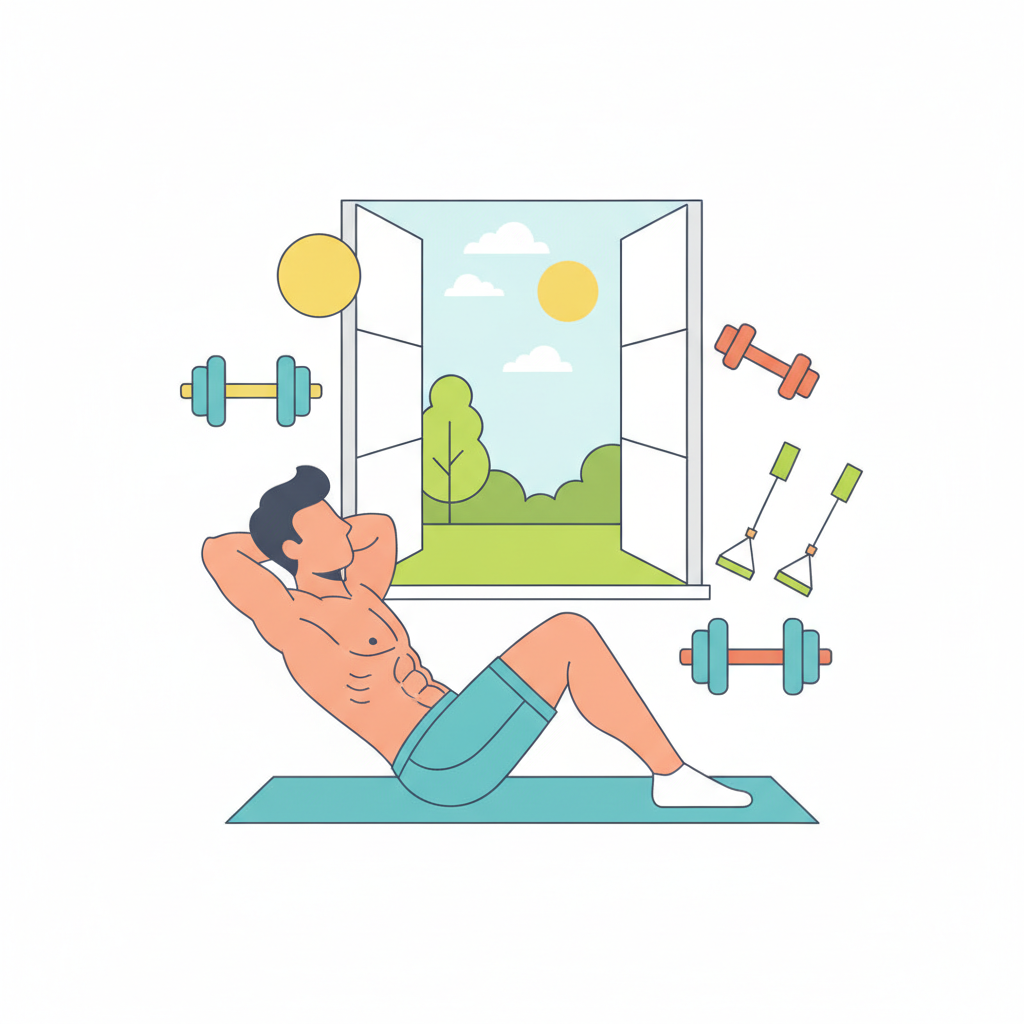
Defined, strong abs are one of the most popular fitness goals. The good news: you don't need a gym membership or expensive equipment to achieve them. All it takes is a clear space on the floor, a mat, and a structured programme. In this article you will find everything you need: anatomy, technique, a workout programme, and a breakdown of common mistakes — so you can start today.
Abs Anatomy: Which Muscles You Are Training
Before jumping into home ab exercises, it is important to understand exactly what you are training. The abdominal muscles are not a single "block" but several layers with different functions.
The rectus abdominis is a long vertical sheet running from the sternum to the pubic bone. It is the muscle that creates the "six-pack" definition when body fat is low. It is activated during trunk flexion: crunches, leg raises, and reverse crunches.
The transverse abdominis lies deeper than the others and acts as an internal corset. It stabilises the spine and creates the effect of a "flat stomach." It is best engaged during the plank, vacuum exercises, and isometric holds.
The obliques — both external and internal — shape the lateral definition and are involved in trunk rotation. They work actively in the bicycle crunch, side planks, and twisting crunches.
Understanding the anatomy has practical value: you consciously select exercises for each section, avoid imbalanced loading, and feel the target muscles better during a set. For example, if you only do classic crunches, the transverse abdominis and obliques will remain almost untrained — your core will be strong but neither functional nor flat.
What You Need for Home Workouts: Minimal Equipment
One of the main advantages of training your core without machines is the minimalist approach. You will need:
- A mat or non-slip surface. Training on a bare floor is uncomfortable: a mat reduces pressure on the spine and keeps your hands from slipping during the plank.
- A phone timer. Many exercises are more conveniently performed for time rather than repetitions: holding a plank for 30–60 seconds is easier to manage with a timer.
- A clear space roughly the length of your body. Nothing else is required.
- Comfortable clothing. No jeans or tight tops — your trunk movement must be unrestricted.
No blocks, ab wheels, or suspension equipment needed. If you want to increase the challenge in the future, simply add a small weight — a dumbbell or a water bottle. But for four weeks of work from scratch, none of that is necessary. For comparison, the best home workout apps in 2025 build effective programmes on exactly this basic setup.
Principles of an Effective Programme: How to Build Progression
Random training produces random results. An abs training programme must be built on several key principles.
Progressive overload. This is the foundation of any physical progress. If every week you perform the same number of repetitions at the same pace, your body adapts and stops developing. Add repetitions, increase the plank hold time, or shorten the rest between sets.
Training frequency — 3–4 times per week. According to the National Academy of Sports Medicine (NASM), core muscles recover faster than large muscle groups, so frequent sessions are acceptable. However, complete rest on at least 2–3 days per week is still necessary.
Alternating loading zones. Each workout should include exercises for the upper region (crunches), the lower region (leg raises), and rotational movements (bicycle, side plank). This ensures even development across all muscle layers.
Technique matters more than quantity. Ten clean crunches with the lower back pressed to the floor are more effective than thirty performed with a jerk and the head thrown back. This is not just advice — it is a matter of safety. Read more about how to create your own workout programme in a dedicated article.
Basic Ab Exercises for Beginners
These five exercises will form the foundation of your home programme. All of them require no equipment and cover the entire core muscle complex.
- Classic crunches. Lie on your back, knees bent, feet flat on the floor. Hands behind your ears or crossed on your chest. Lift your shoulder blades off the floor — not your entire torso. The primary load falls on the rectus abdominis.
- Forearm plank. The key exercise for strengthening the abdominal muscles and the entire core. The transverse abdominis, rectus, glutes, and back all work simultaneously.
- Lying leg raises. Arms along the body or under the sacrum. Raise straight legs to 90° and lower them slowly. Targets the lower portion of the rectus abdominis — an area that crunches barely reach.
- Bicycle crunch. Lying on your back, alternately bring each knee towards the opposite elbow. According to a study by the American Council on Exercise (ACE), the bicycle crunch ranks among the top three most effective exercises for activating the rectus and obliques.
- Reverse crunches. Legs raised, knees slightly bent. Curl the pelvis upward, lifting the lower back off the floor. A good alternative to leg raises for those with lower back pain.
If you are just starting out, combine these exercises with a full-body workout for beginners — the results will be more well-rounded.
The 4-Week Programme: A Weekly Plan by Day
Each week is built on the same exercises but with increasing difficulty.
Week 1 — Mastering Technique
Goal: feel each muscle, learn not to engage the neck and hip flexors.
| Day | Exercises | Sets × Reps |
|---|---|---|
| 1, 3, 5 | Crunches | 3 × 10 |
| Forearm plank | 3 × 20 sec | |
| Leg raises | 3 × 8 | |
| Bicycle crunch | 3 × 10 (each side) |
Warm-up: 3–5 minutes of light walking or joint mobility work. Cool-down: lower back and hip flexor stretching — 3–5 minutes.
Week 2 — Building Volume
Goal: add repetitions, reduce rest periods to 45 seconds.
- Crunches: 3 × 15
- Plank: 3 × 30 sec
- Leg raises: 3 × 12
- Bicycle crunch: 3 × 15
- Reverse crunches: 3 × 10 (new exercise)
Week 3 — Increasing Difficulty
Goal: add lateral loading and raise one leg during the plank.
- Twisting crunches: 3 × 12 each side
- Side plank: 3 × 20 sec each side
- Leg raises + lower without touching the floor: 3 × 12
- Bicycle crunch: 3 × 20
- Straight-arm plank: 3 × 40 sec
Week 4 — Intensification (Circuit Format)
Goal: minimal rest between exercises (15 sec), 3 rounds.
One round:
- Crunches × 20
- Plank × 50 sec
- Bicycle crunch × 25 (each side)
- Leg raises × 15
- Side plank × 30 sec each side
- Reverse crunches × 15
Rest between rounds — 90 seconds.
Technique for Key Exercises: Step-by-Step Instructions
Correct technique is not pedantry — it is a condition for effectiveness and safety.
Crunches. Lie on your back and press your lower back into the floor — this position must be maintained throughout the entire set. Hands behind your ears, elbows wide. Lift your shoulder blades 20–30° off the floor; do not reach your chin forward. Exhale on the way up.
Forearm plank. Elbows directly under the shoulders, forearms parallel to each other. Body forms a straight line from heels to the top of the head. Glutes squeezed, stomach drawn in. Do not let the hips rise or sag. Gaze directed at the floor.
Leg raises. Lie on your back, hands under the sacrum or along the body for support. Raise straight legs to 90°, then lower them slowly — over 3–4 seconds — without letting them touch the floor. The lower back does not lift off the surface at the bottom position.
Side plank. Support yourself on one forearm, body forming a straight line in the lateral plane. Hips must not sag. Free arm on the hip or extended vertically. Breathe steadily.
Mountain climbers. High plank position, shoulders directly over the wrists. Alternately drive each knee toward the chest without rocking the torso. Moderate pace, maintaining a rigid core throughout.
Common Mistakes and How to Avoid Them
Knowing the typical mistakes in advance will save you weeks of wasted training.
- Holding your breath. This is a natural reflex under tension, but it increases intra-abdominal pressure and reduces core activation. The rule is simple: exhale on the effort, inhale on the return.
- Raising the torso too high during crunches. When you come up too far, the hip flexors — the iliopsoas — take over the work. The abs become unloaded. Lifting your shoulder blades is enough.
- Sagging lower back in the plank. The lower back drops, putting excessive strain on the lumbar vertebrae. Maintain a neutral pelvic position.
- Jerking during leg raises. Momentum removes the load from the abs. Slow, controlled movement is the only way to genuinely challenge the lower portion of the rectus abdominis.
- Neglecting the obliques. Many people only do crunches and planks, completely ignoring lateral loading. Without the obliques, the core remains functionally weak.
Also remember: visible ab definition depends on the percentage of subcutaneous fat — training strengthens the muscles, while nutrition determines whether they will be visible. If you are interested in a fat-burning home workout as part of a combined approach, refer to the relevant programme.
FAQ: Common Questions About Training Abs at Home
How often do I need to train my abs to see results? The optimal frequency is 3–4 workouts per week with rest days in between. Core muscles recover faster than large muscle groups, but daily training without rest still slows progress. You will feel the first changes in tone and strength after 2–3 weeks of consistent training; however, visible definition depends primarily on reducing the fat layer through dietary control and overall physical activity.
Why aren't my abs visible even though I train them? The abdominal muscles may be well developed but hidden under a layer of fat. Visible definition depends directly on body fat percentage. Training strengthens and builds the muscles, but only a calorie deficit can "reveal" them. Combine ab exercises with cardio and balanced nutrition — read more about cardio for fat loss.
Can I train abs every day? Technically, core muscles are more endurance-oriented than others and can tolerate more frequent loading. However, daily intense sessions increase the risk of overuse and reduce movement quality. If you want to train every day, alternate intense sessions with lighter ones — for example, a 10-minute plank and stretching on a "light" day.
Is special nutrition needed for ab muscle growth? Protein is the primary building material of muscle tissue. To strengthen the abdominal muscles, it is important to consume adequate protein: use the daily protein intake guidelines based on your weight and goals. No special supplements or diets for abs exist — the rule is simple: sufficient protein + moderate calorie deficit + training.
How can I tell whether the programme is working if I train at home without a trainer? Focus on objective progress markers: your plank hold time increases, your rep counts go up, and exercises that used to feel hard become routine. It is useful to record your numbers after each workout — this helps you see the dynamics and maintain motivation. Read more about how to track workout progress in a dedicated article.
💪 Train smarter with f/ai — the AI coach will create a personalised programme for your goals and adapt it to your progress. Download the app →
Try F/AI — AI Fitness Trainer
Personalized workout plans, AI trainer chat, photo body analysis.
Download for free