What Weight Should a Beginner Squat? How to Pick Your Starting Load
How to choose a starting weight for the barbell squat, how fast to add load, and how to adjust once the first eight weeks are done.
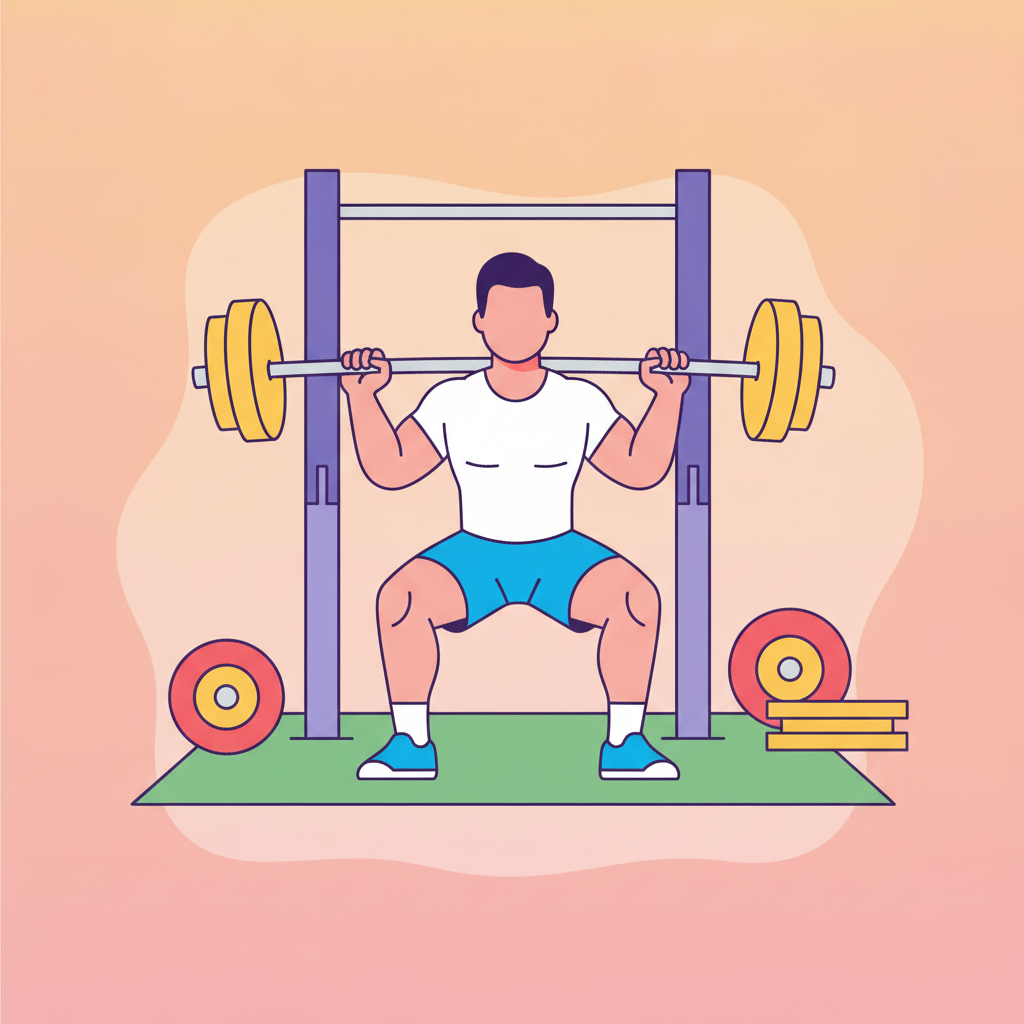
Learning how to squat with a barbell is one of the most valuable investments you can make in your strength training journey. Done correctly, it builds total-body strength, improves your posture, and sets a foundation for almost every other lower-body movement. This guide walks you through proper barbell squat form for beginners, helps you choose the right starting weight, and gives you a concrete 8-week progression plan to follow from your very first session.
Why the Barbell Squat Is the Foundation of Strength Training
No other single exercise recruits as much muscle in one movement. When you squat with a barbell, you simultaneously load your quadriceps, glutes, hamstrings, adductors, spinal erectors, and core. That level of compound muscle recruitment triggers a hormonal and neuromuscular response that isolation exercises simply cannot match.
Compare the barbell back squat to its alternatives:
- Goblet squat — great for learning movement patterns, but limited by how much weight you can hold
- Leg press — targets quads without training spinal stability or core bracing
- Dumbbell squat — grip becomes the limiting factor before your legs are truly challenged
- Smith machine squat — the fixed bar path alters natural movement mechanics
The barbell squat wins for long-term progression because the load sits on your body, forces you to stabilize through your entire kinetic chain, and allows you to add small weight increments over months and years without hitting an artificial ceiling.
This guide is designed for beginners and early-intermediate lifters — people who have either never squatted with a barbell or who have but without a structured plan. By the end of 8 weeks, you will have established consistent form, built a baseline of strength, and learned how to push yourself without breaking down.
How to Squat with a Barbell: Step-by-Step Form Guide
Barbell back squat technique is worth spending real time on before you chase heavy weight. Here is how to set it up correctly.
Bar Position
- High bar: Bar rests on the upper trapezius, directly below the base of the neck. More upright torso, greater quad emphasis. Easier to learn for most beginners.
- Low bar: Bar sits across the rear deltoids, lower on the back. More forward torso lean, greater posterior chain demand. Common in powerlifting.
Start with high bar unless you have a coach guiding you otherwise.
Foot Stance
Stand with feet roughly shoulder-width apart. Turn your toes out 15–30 degrees. Your exact stance depends on your hip anatomy — experiment with small adjustments until your descent feels natural and your knees track directly over your toes.
The Descent
- Take a deep breath into your belly and brace your core hard (like you're about to take a punch)
- Initiate the movement by pushing your hips back and bending your knees simultaneously
- Keep your chest up and your spine neutral
- Descend until your hip crease is at or below parallel with your knee — this is full depth
The Ascent
- Drive through your entire foot (not just your heels)
- Lead with your chest, not your hips
- Keep your knees tracking over your toes
- Lock out fully at the top — stand tall, squeeze glutes
Common Form Mistakes to Avoid
- Knee cave (valgus collapse): Push your knees out actively throughout the lift
- Butt wink (posterior pelvic tilt at depth): Often caused by tight hip flexors or hamstrings — work on mobility
- Excessive forward lean: Usually a cue issue or ankle mobility limitation
- Half-repping: Cutting depth short to lift more weight defeats the purpose
How to Choose Your Starting Weight for the Barbell Squat
The most common beginner mistake is loading the bar too heavy, too soon. Ego-free loading is not optional — it is the strategy that keeps you progressing for years instead of weeks.
Start with the Empty Bar
Most beginners, regardless of athletic background, should begin with just the empty barbell (45 lbs / 20 kg). The bar alone teaches you bar path, bracing, and depth cues without the distraction of heavy load.
Perform a Bodyweight Assessment First
Before touching the bar, do 10 bodyweight squats. Ask yourself:
- Can I hit depth with a neutral spine?
- Do my knees track properly?
- Is my balance stable throughout?
If bodyweight squats feel awkward, spend 1–2 sessions fixing that before adding load.
How Much Weight to Squat as a Beginner
| Fitness Level | Suggested Starting Weight |
|---|---|
| Untrained (no gym history) | Empty bar (45 lbs / 20 kg) |
| Generally active | 45–65 lbs (20–30 kg) |
| Athletic background | 65–95 lbs (30–43 kg) |
Add weight in 5 lb (2.5 kg) increments during your first session until your form begins to waver. The last load where your form held perfectly is your true starting weight.
The Long-Term Payoff of Ego-Free Loading
Lifters who start light and progress steadily build more strength in 6 months than those who load heavy on day one and stall out (or get injured) within weeks.
The 8-Week Barbell Squat Progression Plan
This squat program for strength uses linear progression — the most effective model for beginners.
| Week | Sets × Reps | Load Guideline | Focus Cue |
|---|---|---|---|
| 1 | 3 × 5 | Empty bar or starting weight | Depth and bracing |
| 2 | 3 × 5 | Same load, perfect reps | Knee tracking and chest position |
| 3 | 3 × 5 | +5–10 lbs vs Week 1 | Introduce RPE 6–7 target |
| 4 | 3 × 5 | +5 lbs vs Week 3 | Controlled descent tempo (3 sec down) |
| 5 | 3 × 5 | +5–10 lbs vs Week 4 | Brace harder, drive faster on ascent |
| 6 | 3 × 5 | Optional deload (−20%) | Reset and reinforce technique |
| 7 | 3 × 3 | Heavier load, RPE 8 | Test your strength threshold |
| 8 | 1 × 5 rep max or milestone | Best single working set | Assess and celebrate progress |
Squat frequency: 2–3 times per week with at least one rest day between sessions.
RPE (Rate of Perceived Exertion): A scale from 1–10. RPE 7 means you could do 3 more reps. RPE 9 means 1 rep left in the tank. Use this to gauge load adjustments without maxing out every session.
Progressive Overload: The Science Behind Adding Weight Each Week
Squat progressive overload is the principle that drives all strength gains. In simple terms: your muscles adapt to a given stress. To keep getting stronger, you must gradually increase that stress over time.
Linear Progression for Beginners
As a beginner, your nervous system and muscles are so far from their genetic ceiling that you can add weight every session or every week. This is called linear progression, and it is the fastest gains you will ever experience in your lifting life.
When to Increase vs. Hold
- Increase load when you complete all prescribed reps with good form at RPE 7 or below
- Hold the same load when form breaks down on the final set or RPE exceeds 9
- Reduce load after illness, a significant break, or when a deload week is due
How to Track Your Sessions
Use a simple training log — a notebook, a spreadsheet, or a dedicated app. Record:
- Date
- Weight used
- Sets and reps completed
- RPE for the final set
- A brief note on form quality
Signs You Are Progressing Too Fast
- Form degrades consistently across sessions
- RPE stays at 9–10 every workout
- Joint pain (not muscle soreness) after sessions
- You cannot complete all prescribed reps
Signs You Are Progressing Too Slow
- RPE never exceeds 6
- You haven't added weight in 3+ weeks
- No muscle soreness or fatigue after sessions
Safety Tips and Injury Prevention for Beginner Squatters
Even a technically sound squat can cause problems if you skip your warm-up or ignore pain signals. Here is how to train safely.
Warm-Up Protocol
Never walk into a rack cold. Before your working sets:
- 5 minutes of light cardio (bike or brisk walk)
- Dynamic stretches: leg swings, hip circles, walking lunges
- Ramp-up sets: 2 sets with empty bar, then 1–2 sets at 50–75% of your working weight
Use a Squat Rack with Safety Bars
Always set the safety bars just below your squat depth. If you miss a rep, you can safely dump the bar without injury. This replaces the need for a spotter in most beginner scenarios.
Spotting Guidelines
- A spotter is helpful for heavy loads or when testing a max
- The rack's safety bars handle most situations when set correctly
- Never rely on a spotter who doesn't know the cues — they may pull your bar unevenly
Hip and Ankle Mobility Drills
Limited ankle dorsiflexion and tight hip flexors are the two biggest physical limiters of squat depth. Add these before each session:
- Ankle circles and wall ankle stretches — 30 seconds each side
- 90/90 hip stretch — 60 seconds per side
- Deep squat hold — 30–60 seconds with bodyweight only
Pain vs. Soreness
- Normal: Muscle ache 24–48 hours after squatting (DOMS)
- Investigate: Sharp pain during the lift, pain that doesn't resolve within 72 hours, joint pain (knees, lower back, hips)
- Stop and see a physio: Pain that worsens with each session
How to Measure Progress and Adjust After 8 Weeks
Weight on the bar is only one metric. Here is how to assess what your first 8 weeks actually produced.
Metrics That Matter
- Depth consistency: Are you hitting parallel every rep, not just occasionally?
- Form video review: Film yourself from the side every 2 weeks and compare
- RPE trends: Is the same weight feeling easier? That is adaptation.
- Volume completed: Total reps × sets × weight across the block
What Success Looks Like After 8 Weeks
A realistic beginner outcome following this linear progression model:
- Consistent parallel or below-parallel depth on every set
- 30–60 lbs added to the bar from your starting weight
- Approaching or reaching bodyweight on the bar for a set of 5
- Improved hip and ankle mobility from warm-up drills
Transitioning to Intermediate Programming
Once you can no longer add weight every session, you have outgrown beginner linear progression. Common next steps:
- Texas Method: Higher volume on Monday, light technique day Wednesday, heavy intensity Friday
- 5/3/1 (Jim Wendler): Four-week cycles with percentage-based loading, excellent for building long-term strength
Adjusting Frequency
If you have been squatting twice per week, consider moving to three times. More frequency means more practice with the movement and more opportunities to drive adaptation.
Setting New 8-Week Goals
Use your Week 8 data to set the next block's targets. Be specific:
- "Add 20 lbs to my 5-rep working weight"
- "Achieve consistent depth on every session without a cue reminder"
- "Reduce RPE at current working weight from 8 to 6"
Frequently Asked Questions
How much weight should a beginner squat with a barbell?
Most beginners should start with the empty barbell — 45 lbs or 20 kg — regardless of how fit they feel. The empty bar teaches you bar path, bracing, and depth cues without the distraction of heavy load. Once form is solid, add 5–10 lbs per session in the early weeks. The right starting weight is the heaviest load at which your form stays completely clean on every rep of every set. Rushing past that point is the most common reason beginners plateau or get injured within their first month.
How often should I squat with a barbell as a beginner?
Two to three times per week is the optimal range for beginners. This frequency gives you enough practice repetitions to build a strong motor pattern — the neuromuscular "memory" of how to squat — while leaving adequate recovery time between sessions. Starting with two days per week is fine if you are also doing other lower-body work. Move to three times per week once you feel fully recovered between sessions and want to accelerate your progress.
How do I know if my barbell squat form is correct?
The most reliable method is filming yourself from the side. Key indicators of correct form include: knees tracking over your middle toes throughout the entire movement, your chest staying up and spine staying neutral on the descent and ascent, your hip crease reaching at or below parallel to your knee, and no excessive forward lean or rounding in your lower back. A quick checklist after each set — depth reached, knees out, chest up — keeps you self-correcting before bad habits become ingrained.
What is a good barbell squat weight goal after 8 weeks?
A realistic and meaningful target for a beginner following this 8-week linear progression plan is squatting close to or equal to your bodyweight for a set of five reps with solid form. This varies depending on your starting strength, consistency, and recovery quality. Some lifters will exceed this, others will approach it — both are valid outcomes. The more important measure is how much weight you added relative to where you started, combined with genuine improvement in form depth and consistency.
Can I squat with a barbell if I have knee pain?
Mild muscular discomfort from learning a new movement pattern is common and normal in the first few weeks. However, sharp, clicking, or persistent knee pain is a signal to stop and consult a physiotherapist before continuing. Often, minor tracking issues respond well to simple adjustments: widening your stance slightly, turning your toes out more, or reducing squat depth temporarily while building mobility. Never push through acute joint pain — addressing it early takes days; ignoring it can take months of recovery.
💪 Train smarter with f/ai — an AI coach builds a personal program for your goals and adapts as you progress. Get the app →
Try F/AI — AI Fitness Trainer
Personalized workout plans, AI trainer chat, photo body analysis.
Download for free